



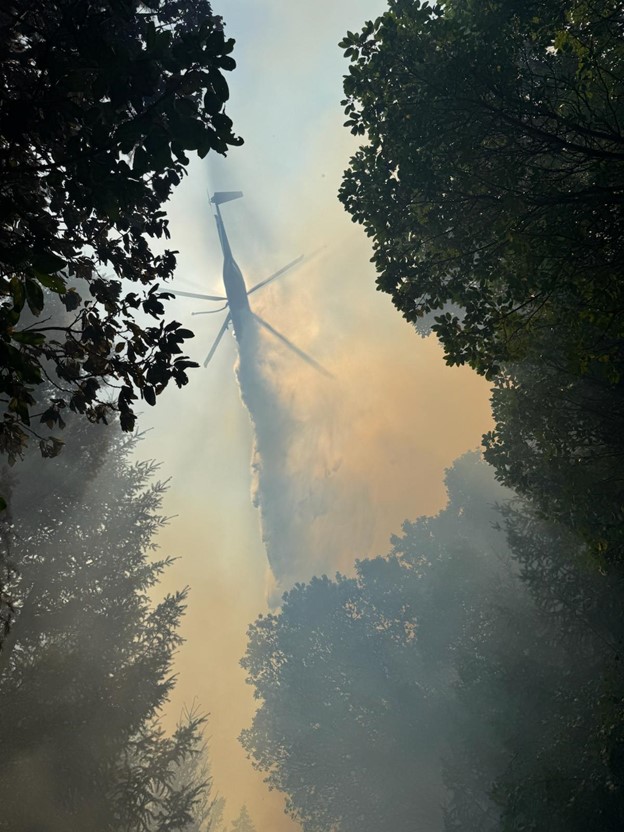
New aviation strategy brings faster, more precise firefighting across the state
SALEM, Ore. — Oregon’s wildfire response is reaching new heights—literally. The Oregon Department of Forestry (ODF) has added regional air attack teams to its firefighting arsenal and continues investing in aircraft that can quickly suppress wildfires before they grow out of control.
“These are excellent investments,” said Kyle Williams, ODF Deputy Director of Fire Operations. “Our regional air attack teams and severity aircraft allow us to fight wildfires with surgical precision—cutting them off quickly in critical areas.”
ODF is Oregon’s largest fire agency, typically responding to more than 1,000 wildfires each year. The vast majority of these fires never make headlines because ODF’s rapid response often contains them before they grow beyond 10 acres.
What Is Air Attack?
Air attack refers to a specialized aircraft and crew that fly above active wildfires to coordinate airborne and ground-based firefighting efforts. Think of it as an aerial command center that ensures water and retardant drops are accurate, safe, and effective.
“Keeping our crews safe is the first priority,” said Michael Curran, ODF’s Chief of Fire Protection. “Air attack helps manage the airspace, direct the aircraft, and maintain constant communication with the firefighters on the ground.”
Air attack teams manage everything from timing and drop zones to coordinating helicopter and fixed-wing aircraft. Their work enables ground crews to build firelines and suppress flames more effectively while avoiding dangerous overlaps.
Why It Matters
Historically, air resources were only dispatched after a wildfire reached a larger, more dangerous size—often too late to contain it quickly. Thanks to increased investment from the Oregon Legislature, ODF now has two regional air attack teams ready to respond during the initial attack phase.
“That’s a game changer,” Williams said. “It allows us to act immediately and keep fires small.”
The addition of regional air attack teams complements Oregon’s long-standing severity aircraft program. These strategic tools help ODF target wildfires early, reduce suppression costs, and better protect Oregon’s communities, forests, and natural resources.
“We’re seeing a huge return on investment,” Curran added. “This approach is saving money, minimizing damage, and most importantly, keeping people safe.”
To learn more about ODF’s wildfire response and preparedness efforts, visit odf.oregon.gov.